Educational resource developed at the Veterinary Anatomy Section, ICAR-Indian Veterinary Research Institute (ICAR-IVRI), Bareilly.
📝 STANDARD DESCRIPTION:
The Skull Floor Comparison:
• Ox (Efficient Fusion): Foramen Orbitorotundum (III, IV, VI, V1, V2); Foramen Ovale (V3—discrete); Jugular Foramen (IX, X, XI—distinct)
• Horse (Complex Separation): Orbital Fissure (III, IV, VI, V1); Foramen Rotundum → Alar Canal (V2); Foramen Lacerum/Oval Notch (V3); Foramen Lacerum caudal (IX, X, XI)
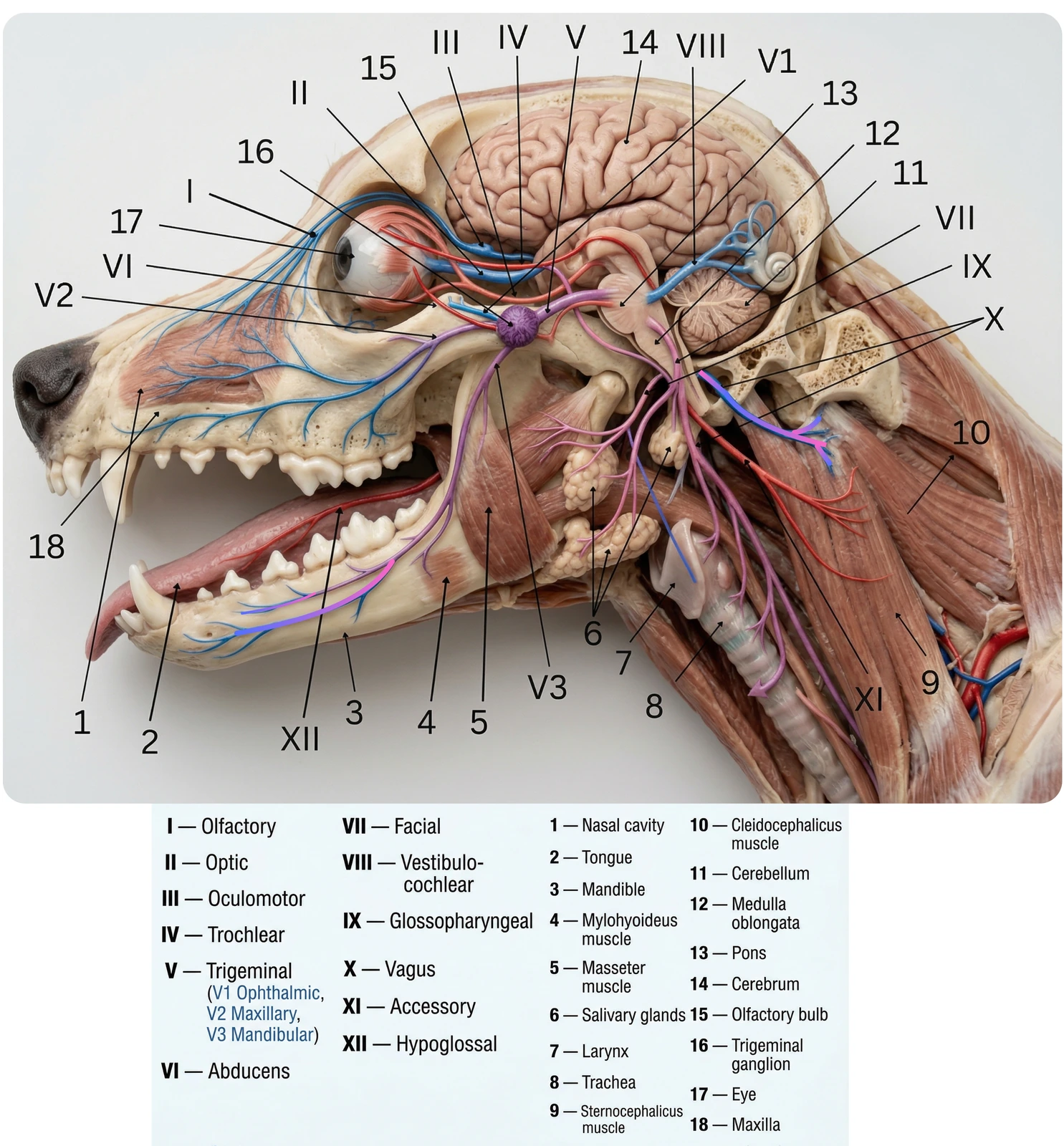
• Dog (Standard Mammal): Separate orbital fissure, rotundum, and ovale; Alar Canal for artery
• Clinical: Single lesion at Foramen Orbitorotundum (ox) affects all orbital nerves simultaneously—profound anesthesia but also profound paralysis risk
📚 DETAILED DESCRIPTION:
Comparative Cranial Exit Anatomy
The skull floors of the Ox, Horse, and Dog differ significantly in their foramina patterns, creating distinct clinical implications for nerve blocks and pathological processes.
The Ox: Fusion and Efficiency
The bovine skull simplifies exits through fusion, creating larger, fewer openings:
Foramen Orbitorotundum: Massive fusion of orbital fissure and foramen rotundum. Transmits CN III, IV, VI, V1, V2, and ophthalmic veins. Located deep in orbit, formed by presphenoid/basisphenoid wings.
Foramen Ovale: Discrete, oval opening in basisphenoid wing transmitting CN V3 (Mandibular nerve). Separate from Jugular Foramen.
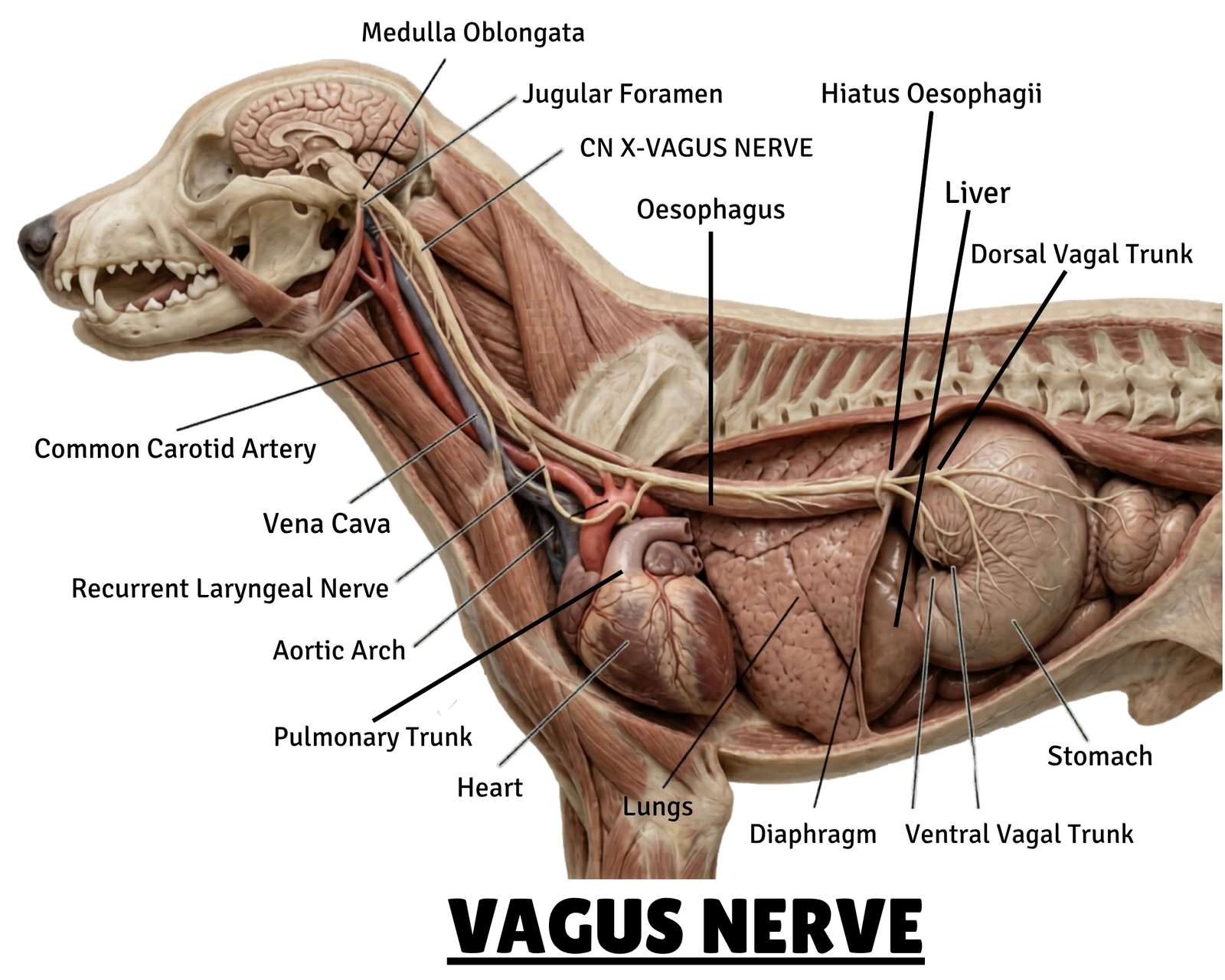
Jugular Foramen: Distinct opening between occipital and temporal bones transmitting CN IX, X, XI and jugular vein bulb.
Angiology: Maxillary artery courses on surface of pterygoid muscles (no Alar Canal).
The Horse: Separation and Complexity
The Equid skull maintains separate exits with complex routing:
Orbital Fissure: Transmits CN III, IV, VI, V1 only.
Foramen Lacerum: Small, filled with cartilage in life.
Clinical Implications
Peterson Eye Block: In cattle, targeting the Foramen Orbitorotundum blocks all orbital nerves (III, IV, VI, V1, V2) simultaneously. In horses, achieving equivalent blockade requires multiple injections or different approaches due to separate foramina.
Surgical Risk: In cattle, a single abscess or tumor at the Foramen Orbitorotundum can paralyze the entire globe and eliminate all facial sensation—anatomical efficiency becomes clinical vulnerability.
Separate Orbital Fissure and Foramen Rotundum. Foramen Lacerum is large irregular gap containing Oval Notch (V3) and Jugular portion (IX, X, XI). Alar Canal present.
DOG (CANIS LUPUS)
Standard pattern: separate fissure, rotundum, and ovale. Alar Canal present for maxillary artery. Foramen Lacerum small.
CLINICAL RELEVANCE
Critical Localization: Complete ophthalmoplegia (paralysis of all eye muscles) with sensory loss to the cornea and upper face in cattle localizes to the Foramen Orbitorotundum region. In horses, such diffuse deficits would suggest a cavernous sinus syndrome or multiple lesions rather than a single foramen issue.
VISUAL REFERENCE
Dog (Canis lupus)
Cranial Exit Overview (I–XII)Cranial Nerves of the Dog — Overview of cranial nerve exits (I–XII) and peripheral branches from the cranial baseJugular Foramen Exit (CN X)Vagus Nerve (CN X) — Illustrating exit of the vagal group through the jugular foramen at the caudal skull base
BIOMECHANICS ENGINE
Comparative Veterinary Biomechanics
The Why of Veterinary Anatomy
Explore the hidden mechanics of why structures are present, absent or modified across domestic and wildlife species—and how each anatomical design supports movement, function and clinical practice.
HIGH-QUALITY VETERINARY IMAGES IN DEVELOPMENTCarefully curated visuals to support anatomical learning are under development and will be added soon.
Category
Structure Name
Vs. Tag
The Biomechanical "Why"
Explanation goes here.
Clinical Relevance
Clinical notes go here.
ENGINEERING CHALLENGE
Choose your arena
How many questions?
Q1/10
Score0
Streak0
Topic
Loading challenge...
Session Complete
8 / 10
Excellent
Best streak0
Accuracy0%
TopicAll
SELECT REGIONAL ANATOMY
STEP 1 OF 3
SELECT SYSTEM
REGION > SYSTEM
SELECT CHALLENGE FORMAT
REGION > SYSTEM > FORMAT
MULTIPLE CHOICE
0 questions
Select the best answer from options
TRUE / FALSE
0 questions
Test your knowledge with binary choices
FILL IN BLANKS
0 questions
Type the correct answer
EXAM MODE
Timed mock exam
Customisable: pick duration + question count + format. No instant feedback — like a real exam.
Configure Your Exam
REGION > SYSTEM
Available: ? questions in this pool
Q 1/10
RegionSystem
00:00
Loading...
PrevNext
Question Navigator
Current Correct Incorrect Unanswered Bookmarked
PERFORMANCE ANALYSIS
SESSION REPORT
0%
ACCURACY
0
CORRECT
0
INCORRECT
0
UNANSWERED
0m 0s
TIME TAKEN
PROFESSIONAL RECOMMENDATION:
...
Category Breakdown
DETAILED REVIEW
PERFORMANCE DASHBOARD
Accuracy Trend
Last 20 sessions
Topic Strength Map
Accuracy by Syllabus Unit × Topic
Recent Quiz History
Your last sessions
Welcome back, student
Your study companion for Anatomy
0Bookmarks
0Highlights
0Notes
0Read
0
day streak
0longest
0total days
Last 12 weeks
LessMore
Navigation position Choose where the menu bar sits on desktop. Mobile always stays at the bottom.
Why this matters: Your bookmarks, notes, highlights, and quiz progress live in your browser only.
If you clear browser data, switch phones, or use incognito by accident, they're gone forever.
Download a backup at least once a month and keep the JSON file in Google Drive / WhatsApp to yourself.
Veterinary Anatomy Studio
EXPLORING ANATOMY THROUGH TECHNOLOGY.
Overview
An interactive, curriculum aligned veterinary anatomy platform for B.V.Sc., M.V.Sc. and DVM students worldwide. Developed at ICAR–Indian Veterinary Research Institute, Bareilly, it brings together regional anatomy, histology, embryology, comparative biomechanics, clinical relevance, quizzes and revision.
Vision
To make veterinary anatomy approachable, comparative, and clinically grounded — for every B.V.Sc student, on every device, even offline.
Mission
Cover the complete VCI Unit 1–8 syllabus with high-resolution comparative content.
Pair every structure with its biomechanical "why" and clinical correlation.
Make active recall the default — MCQ, True/False, Fill-in, Smart Review, Exam Mode.
Stay free, ad-free, and lightweight enough to run on any phone.