Anatomical Position & Descriptive Terms Veterinary Anatomy
/// STANDARD MORPHOLOGY // GENERAL ANATOMY
Educational resource developed at the Veterinary Anatomy Section, ICAR-Indian Veterinary Research Institute (ICAR-IVRI), Bareilly.
📝 STANDARD DESCRIPTION:
Standard Anatomical Position — the animal stands on all four limbs, head facing forward, eyes & nose horizontal.
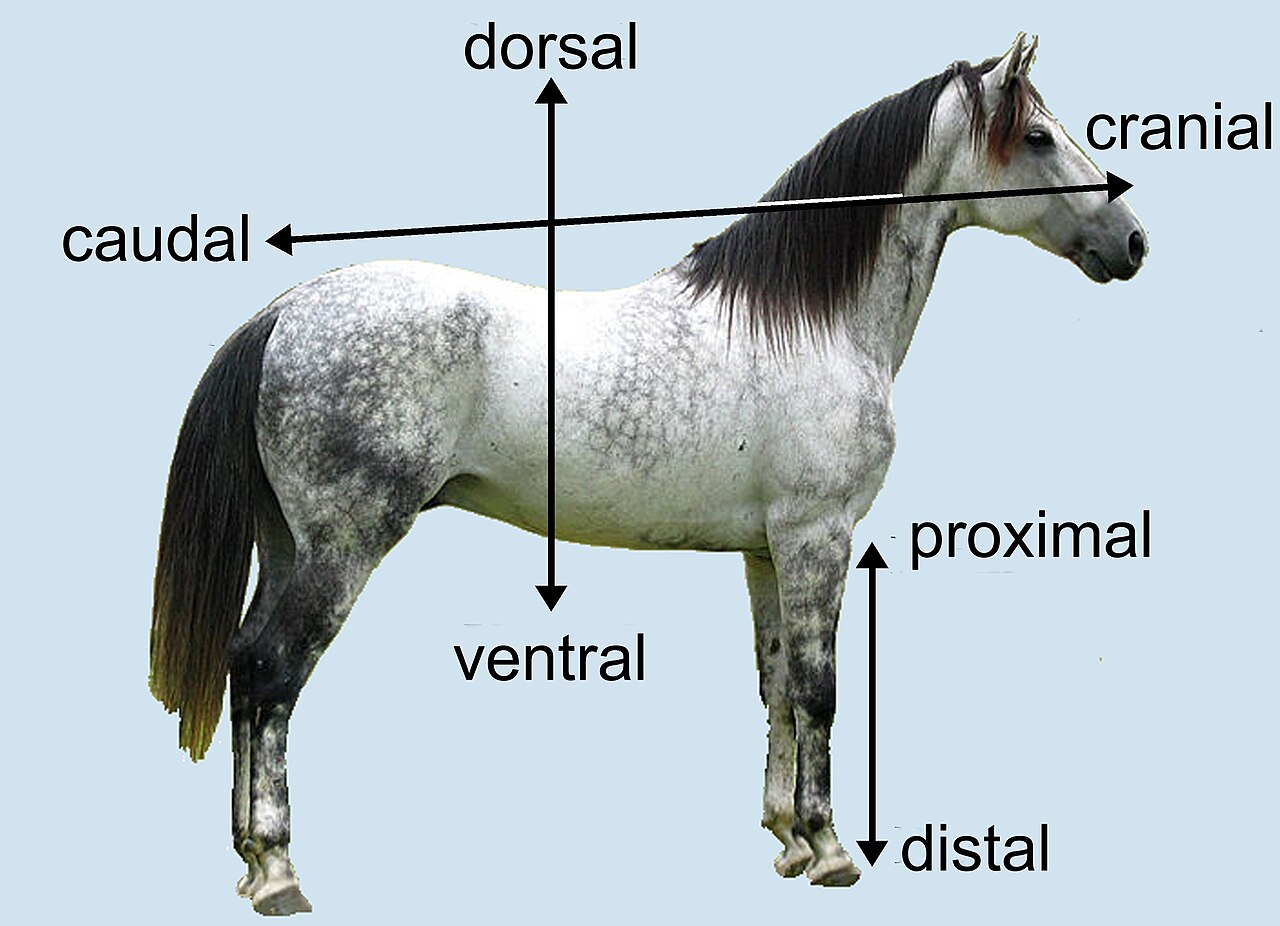
Directional Terms (must memorise): • Cranial / Rostral = toward the head (rostral is used in front of the eye). • Caudal = toward the tail. • Dorsal = toward the back (top). • Ventral = toward the belly (bottom). • Medial = toward the midline. • Lateral = away from the midline. • Proximal = near the body trunk (in limbs). • Distal = far from the body trunk. • Palmar / Plantar = back of forelimb foot / hindlimb foot (after carpus / tarsus). • Dorsal (in limbs distal to carpus/tarsus) = front of foot. • Superficial / Deep — relative to skin surface. • External / Internal — relative to body cavity.
📚 DETAILED DESCRIPTION:
ANATOMICAL POSITION & DIRECTIONAL TERMS
The reference position for veterinary anatomy is the animal standing squarely on all four limbs, head looking forward, eyes/nose horizontal. All directions are described relative to this position, NOT relative to the observer.
1. AXIAL DIRECTIONS (along the body's long axis): • Cranial — toward the head. Used for the trunk and limbs proximal to the carpus/tarsus. • Rostral — toward the tip of the nose. Used inside the head only (e.g., 'rostral to the eye'). • Caudal — toward the tail.
2. DORSO-VENTRAL: • Dorsal — toward the back/spine. • Ventral — toward the belly/sternum.
3. MEDIO-LATERAL: • Medial — toward the median (midline) plane. • Lateral — away from it.
4. LIMB-SPECIFIC TERMS (proximal vs distal to carpus/tarsus): • Proximal — closer to the trunk. • Distal — farther from the trunk. • Above carpus/tarsus, the front of the limb is called cranial and the back caudal. • Distal to the carpus/tarsus, the front becomes dorsal and the back becomes palmar (forelimb) or plantar (hindlimb).
5. RELATIVE POSITION: • Superficial — closer to the skin. • Deep / Profundus — farther from skin. • External / Internal — relative to a body cavity. • Axial / Abaxial — toward or away from the central axis of a digit (used in cloven-footed animals — e.g. 'axial groove of the medial claw'). • Ipsilateral / Contralateral — same side / opposite side. • Bilateral / Unilateral — both sides / one side.
6. MOVEMENT TERMS: • Flexion — decrease joint angle. • Extension — increase joint angle. • Adduction — toward midline. • Abduction — away from midline. • Rotation — turning around long axis. • Circumduction — circular movement. • Pronation/Supination — rotating limb so palm faces down/up (mostly in dog & humans). • Protraction/Retraction — moving limb forward/backward.
// COMPARATIVE ANALYSIS
ALL QUADRUPEDS
'Anterior/Posterior' and 'Superior/Inferior' are HUMAN terms — DO NOT use in vet anatomy. Use cranial/caudal & dorsal/ventral instead.
CLINICAL RELEVANCE
Communication: Surgical and radiographic reports MUST use these terms exactly. 'Lateral oblique radiograph of left manus' is unambiguous; 'side view of left front foot' is not.
VISUAL REFERENCE
Quadruped Directional Terminology
EQUINE DIRECTIONAL AXESStandard veterinary anatomical directions on a standing quadruped: cranial, caudal, rostral, dorsal, ventral, proximal, distal, palmar, and plantar (Wikimedia Commons, CC BY-SA 2.5).CANINE DIRECTIONAL AXESSchematic directional arrows illustrating cranial, caudal, dorsal, ventral, rostral, proximal, and distal axes on the standing dog (Public Domain, Wikimedia Commons).
BIOMECHANICS ENGINE
Comparative Veterinary Biomechanics
The Why of Veterinary Anatomy
Explore the hidden mechanics of why structures are present, absent or modified across domestic and wildlife species—and how each anatomical design supports movement, function and clinical practice.
HIGH-QUALITY VETERINARY IMAGES IN DEVELOPMENTCarefully curated visuals to support anatomical learning are under development and will be added soon.
Category
Structure Name
Vs. Tag
The Biomechanical "Why"
Explanation goes here.
Clinical Relevance
Clinical notes go here.
ENGINEERING CHALLENGE
Choose your arena
How many questions?
Q1/10
Score0
Streak0
Topic
Loading challenge...
Session Complete
8 / 10
Excellent
Best streak0
Accuracy0%
TopicAll
SELECT REGIONAL ANATOMY
STEP 1 OF 3
SELECT SYSTEM
REGION > SYSTEM
SELECT CHALLENGE FORMAT
REGION > SYSTEM > FORMAT
MULTIPLE CHOICE
0 questions
Select the best answer from options
TRUE / FALSE
0 questions
Test your knowledge with binary choices
FILL IN BLANKS
0 questions
Type the correct answer
EXAM MODE
Timed mock exam
Customisable: pick duration + question count + format. No instant feedback — like a real exam.
Configure Your Exam
REGION > SYSTEM
Available: ? questions in this pool
Q 1/10
RegionSystem
00:00
Loading...
PrevNext
Question Navigator
Current Correct Incorrect Unanswered Bookmarked
PERFORMANCE ANALYSIS
SESSION REPORT
0%
ACCURACY
0
CORRECT
0
INCORRECT
0
UNANSWERED
0m 0s
TIME TAKEN
PROFESSIONAL RECOMMENDATION:
...
Category Breakdown
DETAILED REVIEW
PERFORMANCE DASHBOARD
Accuracy Trend
Last 20 sessions
Topic Strength Map
Accuracy by Syllabus Unit × Topic
Recent Quiz History
Your last sessions
Welcome back, student
Your study companion for Anatomy
0Bookmarks
0Highlights
0Notes
0Read
0
day streak
0longest
0total days
Last 12 weeks
LessMore
Navigation position Choose where the menu bar sits on desktop. Mobile always stays at the bottom.
Why this matters: Your bookmarks, notes, highlights, and quiz progress live in your browser only.
If you clear browser data, switch phones, or use incognito by accident, they're gone forever.
Download a backup at least once a month and keep the JSON file in Google Drive / WhatsApp to yourself.
Veterinary Anatomy Studio
EXPLORING ANATOMY THROUGH TECHNOLOGY.
Overview
An interactive, curriculum aligned veterinary anatomy platform for B.V.Sc., M.V.Sc. and DVM students worldwide. Developed at ICAR–Indian Veterinary Research Institute, Bareilly, it brings together regional anatomy, histology, embryology, comparative biomechanics, clinical relevance, quizzes and revision.
Vision
To make veterinary anatomy approachable, comparative, and clinically grounded — for every B.V.Sc student, on every device, even offline.
Mission
Cover the complete VCI Unit 1–8 syllabus with high-resolution comparative content.
Pair every structure with its biomechanical "why" and clinical correlation.
Make active recall the default — MCQ, True/False, Fill-in, Smart Review, Exam Mode.
Stay free, ad-free, and lightweight enough to run on any phone.