Functions of Bone: 1. Support — body framework. 2. Protection — brain, spinal cord, heart, lungs. 3. Movement — levers for muscle action. 4. Mineral storage (Ca, P). 5. Haematopoiesis (red marrow). 6. Energy storage (yellow marrow = fat).
Composition: ~33% organic (mainly Type I collagen — 'ossein'), ~67% inorganic (calcium hydroxyapatite).
📚 DETAILED DESCRIPTION:
BONE — A LIVING COMPOSITE MATERIAL
Bone is a remarkable composite of collagen fibres + mineral crystals (hydroxyapatite). Collagen gives tensile strength (resists pulling); mineral gives compressive strength (resists crushing) — together they outperform any single material engineering can produce.
COMPOSITION: • 33% organic — mainly Type I collagen ('ossein') + ground substance (proteoglycans). • 67% inorganic — Calcium hydroxyapatite Ca₁₀(PO₄)₆(OH)₂ crystals deposited along collagen fibres. • Water — small but functional fraction.
BONE CELLS (4 types): • Osteoblasts — bone-forming cells (build matrix). • Osteocytes — mature osteoblasts trapped in their own matrix; live in lacunae, communicate via canaliculi. • Osteoclasts — large multinucleate bone-resorbing cells (derived from monocytes). • Bone-lining cells — quiescent cells on bone surfaces.
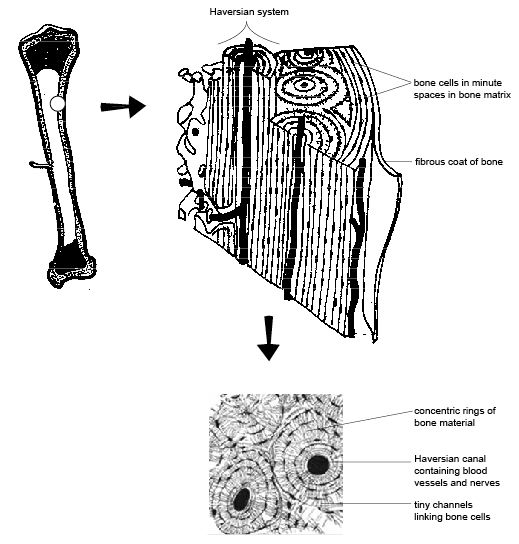
BONE TYPES (Histological): • Compact (cortical) bone — dense outer shell; arranged in Haversian systems (osteons). • Cancellous (spongy/trabecular) bone — internal latticework; aligned along stress lines.
BONE FORMATION (Ossification): • Intramembranous — direct from mesenchyme (flat bones of skull, mandible). • Endochondral — replaces a cartilage model (long bones of limbs).
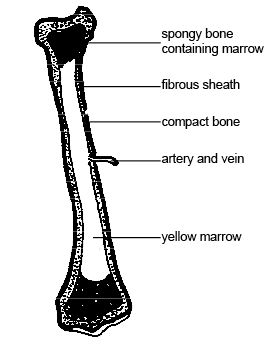
STRUCTURE OF A LONG BONE: • Diaphysis = shaft, with central medullary cavity. • Epiphyses = ends, covered by articular hyaline cartilage. • Metaphysis = junction zone with growth plate (epiphyseal plate / physis) in the young animal. • Periosteum — fibrous outer covering; rich in osteoblasts and blood vessels. • Endosteum — thin lining of medullary cavity. • Nutrient foramen — passage for nutrient artery.
// COMPARATIVE ANALYSIS
BIRD
Pneumatic bones — many bones (humerus, sternum, vertebrae) are hollow and filled with air sacs to reduce weight for flight.
MAMMAL
Bones contain marrow only (red or yellow) — solid, dense.
AQUATIC MAMMALS
Pachyostotic bones in hippos/dugongs — extra-dense bones used as ballast for diving.
CLINICAL RELEVANCE
Bone Marrow Aspiration: Sites — sternum or wing of ilium (cattle/horse), iliac crest or proximal humerus (dog). Used in haematology (anaemia, leukaemia diagnosis). Fracture healing: Depends on intact periosteum + nutrient artery + osteoblast activity.
VISUAL REFERENCE
Long Bone Macroscopic & Microscopic Architecture
LONGITUDINAL SECTION OF LONG BONELongitudinal section of a mammalian long bone showing the diaphysis, epiphyses, articular hyaline cartilage, compact cortical bone, spongy cancellous bone, periosteum, medullary cavity, and nutrient artery (Lawson, Anatomy and Physiology of Animals, CC BY 3.0).HAVERSIAN SYSTEM (OSTEON)Microscopic structure of compact cortical bone showing concentric calcified lamellae, central Haversian canal, osteocytes in lacunae, and radiating canaliculi (Lawson, Anatomy and Physiology of Animals, CC BY 3.0).ENDOCHONDRAL OSSIFICATION & PHYSISProgressive stages of endochondral ossification from a hyaline cartilage model to primary diaphyseal and secondary epiphyseal ossification centres separated by the epiphyseal growth plate (Lawson, Anatomy and Physiology of Animals, CC BY 3.0).
BIOMECHANICS ENGINE
Comparative Veterinary Biomechanics
The Why of Veterinary Anatomy
Explore the hidden mechanics of why structures are present, absent or modified across domestic and wildlife species—and how each anatomical design supports movement, function and clinical practice.
HIGH-QUALITY VETERINARY IMAGES IN DEVELOPMENTCarefully curated visuals to support anatomical learning are under development and will be added soon.
Category
Structure Name
Vs. Tag
The Biomechanical "Why"
Explanation goes here.
Clinical Relevance
Clinical notes go here.
ENGINEERING CHALLENGE
Choose your arena
How many questions?
Q1/10
Score0
Streak0
Topic
Loading challenge...
Session Complete
8 / 10
Excellent
Best streak0
Accuracy0%
TopicAll
SELECT REGIONAL ANATOMY
STEP 1 OF 3
SELECT SYSTEM
REGION > SYSTEM
SELECT CHALLENGE FORMAT
REGION > SYSTEM > FORMAT
MULTIPLE CHOICE
0 questions
Select the best answer from options
TRUE / FALSE
0 questions
Test your knowledge with binary choices
FILL IN BLANKS
0 questions
Type the correct answer
EXAM MODE
Timed mock exam
Customisable: pick duration + question count + format. No instant feedback — like a real exam.
Configure Your Exam
REGION > SYSTEM
Available: ? questions in this pool
Q 1/10
RegionSystem
00:00
Loading...
PrevNext
Question Navigator
Current Correct Incorrect Unanswered Bookmarked
PERFORMANCE ANALYSIS
SESSION REPORT
0%
ACCURACY
0
CORRECT
0
INCORRECT
0
UNANSWERED
0m 0s
TIME TAKEN
PROFESSIONAL RECOMMENDATION:
...
Category Breakdown
DETAILED REVIEW
PERFORMANCE DASHBOARD
Accuracy Trend
Last 20 sessions
Topic Strength Map
Accuracy by Syllabus Unit × Topic
Recent Quiz History
Your last sessions
Welcome back, student
Your study companion for Anatomy
0Bookmarks
0Highlights
0Notes
0Read
0
day streak
0longest
0total days
Last 12 weeks
LessMore
Navigation position Choose where the menu bar sits on desktop. Mobile always stays at the bottom.
Why this matters: Your bookmarks, notes, highlights, and quiz progress live in your browser only.
If you clear browser data, switch phones, or use incognito by accident, they're gone forever.
Download a backup at least once a month and keep the JSON file in Google Drive / WhatsApp to yourself.
Veterinary Anatomy Studio
EXPLORING ANATOMY THROUGH TECHNOLOGY.
Overview
An interactive, curriculum aligned veterinary anatomy platform for B.V.Sc., M.V.Sc. and DVM students worldwide. Developed at ICAR–Indian Veterinary Research Institute, Bareilly, it brings together regional anatomy, histology, embryology, comparative biomechanics, clinical relevance, quizzes and revision.
Vision
To make veterinary anatomy approachable, comparative, and clinically grounded — for every B.V.Sc student, on every device, even offline.
Mission
Cover the complete VCI Unit 1–8 syllabus with high-resolution comparative content.
Pair every structure with its biomechanical "why" and clinical correlation.
Make active recall the default — MCQ, True/False, Fill-in, Smart Review, Exam Mode.
Stay free, ad-free, and lightweight enough to run on any phone.